
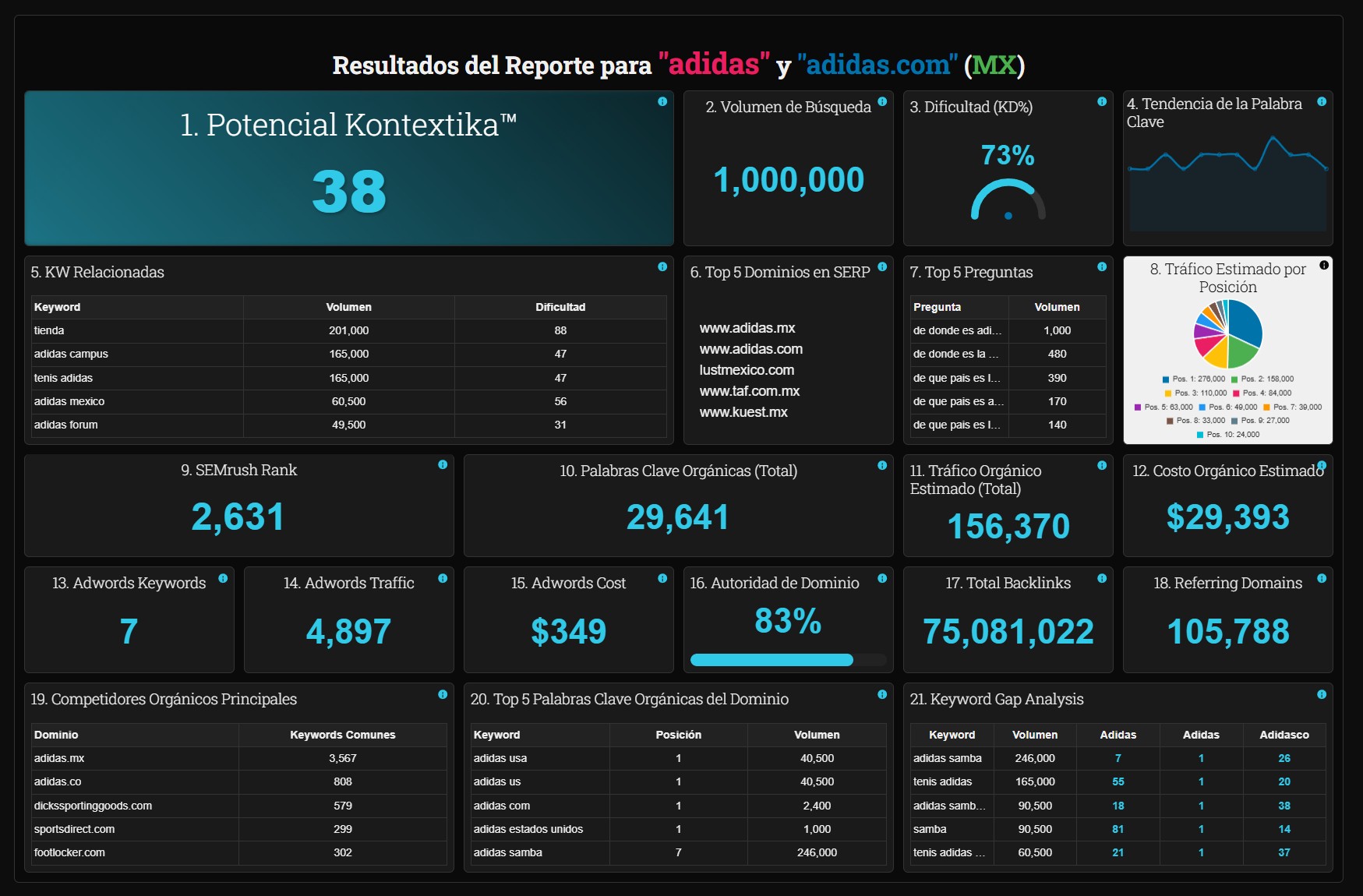
Welcome to the glossary of metrics for your personalized report. Understanding each of these indicators is crucial for dominating your market and making data-driven strategic decisions. Below, we present a summary of the most important metrics you’ll find in your dashboard.
| Metric | Details |
| 1. Kontéxtika Potential™ | Domain: Calculates a combination of your domain’s power, thematic relevance, and the efficiency with which you convert traffic into leads for your niche. It’s a proprietary Kontéxtika metric designed to give you a quick overview of your growth potential. |
| 2. Search Volume | The average number of monthly searches for a specific keyword over a determined period. It indicates the demand for information for that term. |
| 3. Keyword Difficulty (KD%) | Shows the estimated difficulty of ranking organically in search results for a given keyword. A higher percentage signifies more competition. |
| 4. Keyword Trend in Domain | How the interest in a keyword or set of keywords has evolved over time, showing growth or decline patterns. |
| 5. Related Keywords | A list of semantically similar keywords or terms that users also search for in relation to your main keyword. Helps in content expansion and topical authority. |
| 6. Top 5 Domains in SERP for Keyword | The websites occupying the first five positions in the Search Engine Results Pages (SERP) for the analyzed keyword. These are your direct competitors for that specific term. |
| 7. Top 5 Questions for Keyword | The most frequent questions users ask in search engines related to your keyword. Ideal for creating content that answers these queries (e.g., FAQ sections, blog posts). |
| 8. Estimated Traffic by Position | The estimated percentage of clicks a specific search result position receives for a keyword, helping to forecast potential organic traffic if that position is achieved. |
| 9. SEMrush Rank | A domain’s global ranking within the SEMrush database, based on its organic and paid performance. A lower number indicates a higher rank and stronger visibility. |
| 10. Organic Keywords (Total) | The total number of keywords for which a domain is ranking in organic search results. |
| 11. Estimated Organic Traffic (Total) | The total estimated volume of traffic a domain receives through organic search results. |
| 12. Estimated Organic Cost | The estimated monetary value of a domain’s organic traffic if it had to be acquired through paid advertising (PPC). |
| 13. Google Ads Keywords | The keywords a domain is bidding on in its Google Ads (formerly AdWords) advertising campaigns. |
| 14. Google Ads Traffic | The estimated traffic volume a domain receives through its paid advertising campaigns (Google Ads). |
| 15. Google Ads Cost | The estimated cost of a domain’s paid advertising campaigns. |
| 16. Domain Authority (AScore) | A metric that rates a website’s authority and trustworthiness, based on factors like its backlink profile. A higher score indicates greater authority. |
| 17. Total Backlinks | The total number of external links pointing to a specific domain. |
| 18. Referring Domains | The number of unique domains that have at least one outbound link pointing to your website. |
| 19. Main Organic Competitors | Other websites that are competing for the same organic keywords as your domain. |
| 20. Top 5 Organic Keywords of the Domain | The five primary keywords for which a domain is getting the most organic traffic. |
| 21. Keyword Gap Analysis | A tool to identify keywords your competitors are ranking for, but your domain isn’t. It reveals valuable content and SEO opportunities. |
We hope this glossary helps you better understand your report. Now that you have a general overview, we invite you to deep dive into each metric.
Ready to transform this data into results?
Generate your complete report with Kontéxtika and align your engines for success!